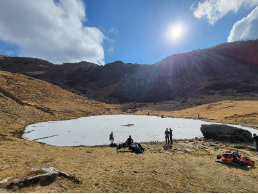
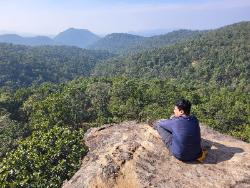
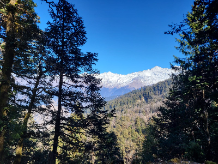
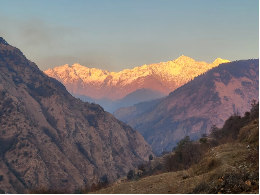
At 3,900 metres above sea level, somewhere between a Himalayan ridge and complete exhaustion, I had one of the clearest strategic insights of my entrepreneurial career. No whiteboard. No deck. Just thin air, burning legs, and sudden clarity. That’s when I understood: the trail doesn’t just test you physically. It teaches you how to build something that lasts. I’ve spent years navigating the waste management and sustainability space at Vermigold Ecotech — a sector that demands long-term thinking, operational discipline, and composure under pressure. And the best preparation I’ve found isn’t an MBA or a management retreat. It’s lacing up my boots and heading out — into the Himalayas, the dense forests of Central India, or the familiar trails around Mumbai.
Here are the seven principles the trail has burned into me — each one as relevant at 5,000 metres as it is in a boardroom:
Endurance Beats Intensity: Mountains don’t reward speed. They reward pacing. I’ve watched fit trekkers burn out by noon while slower, steadier climbers reach the summit. Sustainability businesses are identical — impact accumulates through daily discipline, not bursts of brilliance. The compounding effect of consistent progress, especially when conditions are harsh and results feel invisible, is what separates ventures that endure from those that fade.
Systems Outperform Individual Effort: Raw fitness gets you nowhere on a serious trek if your layering system fails, your hydration is off, or your rest schedule breaks down. The mountain doesn’t care how motivated you are. In waste management, outcomes don’t come from heroics — they come from systems that operate quietly and consistently, long after the excitement of launch fades. Firefighting feels productive. Systems are what scale.
Adaptation is Non-Negotiable: The gear that saves your life on a sub-zero Himalayan pass will exhaust you on a humid forest trail in Central India. You don’t get to carry yesterday’s strategy into today’s terrain. Entrepreneurship is the same — markets shift, regulations evolve, customer needs change. The ability to pivot without losing sight of the core mission is not just useful. In a sector like ours, it’s survival.
Frugality Sharpens Judgment: Every unnecessary gram in your pack is a tax you pay on every uphill step. Trekkers who over-pack don’t just struggle — they make poor decisions when it counts. Scarcity on the trail is not a punishment; it’s a filter. It forces you to distinguish what is essential from what is merely comfortable. I’ve brought this lens back to Vermigold: constraints are not a weakness — they are one of the clearest tools for sharpening judgment and exposing what really matters.
Nature Teaches Structural Integrity: Spend enough time in the wild and something fundamental shifts in how you see waste. In a forest ecosystem, there is no such thing as garbage — every output is an input somewhere else. This is not a metaphor; it’s the operating principle of the natural world. At Vermigold, this is the foundation we build on. Sustainability cannot be bolted onto a business as a marketing layer. It must be embedded in the structural design — the same way a forest embeds it into every cycle of life and decay.
Silence Improves Decisions: Hours into a long trail, the mental chatter slows and something else takes its place — a kind of focused stillness that’s almost impossible to manufacture in an office. Some of my clearest strategic decisions have arrived not in meetings, but in the silence between footsteps. In a world of constant pings, alerts, and opinions, the ability to step away and think without interruption is not a luxury — it is a competitive advantage that most leaders never develop.
Leadership is a Collective Journey: On the trail, the team moves at the speed of the slowest member. There is no workaround, no shortcut, and no leaving anyone behind — not if you want everyone to reach the top. Extreme conditions strip away hierarchy and expose something more fundamental: interdependence. The strongest person on the mountain is only as effective as the support they give and receive. Sustainable businesses are built exactly this way — by resilient teams who carry each other through the hard terrain.
The Trail Doesn’t Lie
Nature is the original systems engineer. It has been solving for efficiency, adaptation, and zero waste for billions of years — and it teaches through discomfort, not comfort. Every hard climb I’ve done has made me a sharper thinker, a more patient leader, and a clearer decision-maker. For me, the trail isn’t an escape from the work of building Vermigold. It is the work. If you’re an entrepreneur who hasn’t spent serious time outdoors lately, I’d ask you this: where else are you going to find seven hours of uninterrupted thinking, a full-body stress test, and a masterclass in systems design — all at the same time?
Jaideep Saptarshi
Founder & CEO, Vermigold Ecotech