

The Hidden Shift Happening i
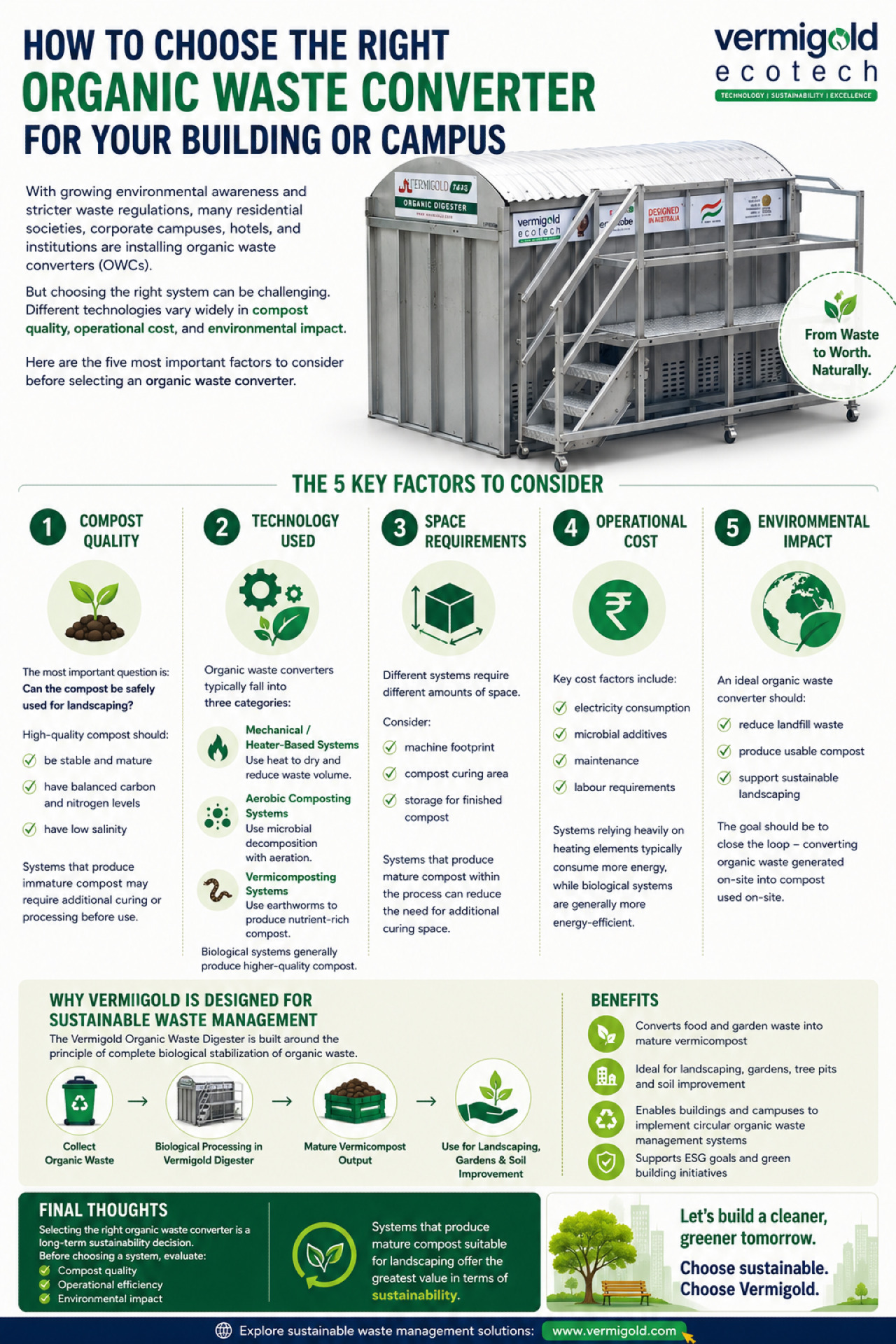
n Waste Management
Every day, thousands of apartment complexes, hotels, educational campuses, hospitals, and corporate facilities generate large volumes of food waste and biodegradable waste.
For decades, most organizations viewed this waste as a disposal problem.
Today, that mindset is changing.
Across cities and institutions, sustainability goals are becoming more ambitious:
Zero waste to landfill initiatives
ESG reporting requirements
BRSR compliance
Green building certifications
Carbon reduction targets
Circular economy commitments
As a result, organizations are increasingly investing in Organic Waste Converters (OWCs) to process waste directly at source.
But once the decision to process waste on-site is made, another critical question emerges:
Which composting technology actually creates the best long-term environmental outcome?
At first glance, many composting systems appear similar.
Most promise:
Rapid waste processing
Odour control
Reduced landfill disposal
Sustainability benefits
However, the reality beneath the surface is very different.
Because not all organic waste processing systems work in the same way.
And more importantly:
Not all systems produce the same quality of compost.
The Speed Trap in Modern Composting Systems
In today’s market, many organizations are drawn toward systems that promise one thing above all else:
Speed.
“Process waste within 24 hours.”
“Rapid composting.”
“Instant organic waste reduction.”
On paper, this sounds impressive.
For facility managers under pressure to quickly solve waste handling challenges, rapid heater-based composters often appear to be an easy answer.
These systems typically rely on:
electrical heaters
mechanical mixing
thermal dehydration
accelerated moisture removal
The primary objective is simple:
Reduce waste volume as quickly as possible.
And in many cases, they succeed in doing exactly that.
But here is the problem most buyers do not initially realize:
Rapid drying is not the same as biological compost stabilization.
This distinction changes everything.
Why Compost Quality Matters More Than Processing Speed
The true purpose of an organic waste management system is not merely reducing waste volume.
The real goal is to create:
stable compost
usable compost
environmentally safe compost
nutrient-rich compost suitable for landscaping and soil enrichment
When organic waste is processed too quickly through heat and dehydration, the biological decomposition cycle may remain incomplete.
The output may appear dry externally, but internally:
microbial stabilization may still be incomplete
organic matter may remain partially decomposed
carbon levels may remain high
compost maturity may be low
As a result, the material often requires:
additional curing
open-air stabilization
secondary composting
further microbial activity
before it can safely support landscaping or horticulture use.
For organizations pursuing long-term sustainability goals, this becomes a critical issue.
Because the question is no longer:
“How fast was the waste processed?”
The real question becomes:
“Can the output safely and effectively return to the soil?”
The Science Behind Compost Maturity
One of the most important indicators of compost quality is the:
Carbon-to-Nitrogen Ratio (C:N Ratio)
Microorganisms responsible for decomposition require:
Carbon as an energy source
Nitrogen for growth and protein formation
A balanced C:N ratio supports:
stable microbial activity
complete decomposition
mature compost formation
Typical compost benchmarks include:
Compost Condition | Typical C:N Ratio |
|---|---|
Raw Organic Waste | 40–80 |
Active Composting | 25–35 |
Mature Compost | 10–20 |
When compost remains biologically immature:
decomposition continues after application
soil nitrogen may become temporarily unavailable
plant growth may weaken
odor generation may increase
This is why compost maturity matters far more than processing speed alone.
The Shift Toward Biological Composting Systems
As sustainability practices evolve, organizations are beginning to rethink what successful waste management actually means.
The focus is slowly shifting from:
“How quickly can waste disappear?”
to:
“How effectively can waste become a valuable environmental resource?”
This is where biological composting systems create a fundamentally different outcome.
Unlike rapid heater-based technologies, biological systems work with natural decomposition processes rather than forcing accelerated dehydration.
These systems rely on:
microbial digestion
controlled aerobic decomposition
oxygen stabilization
gradual biological breakdown
vermicomposting using earthworms
The objective is not simply rapid reduction.
The objective is:
complete biological stabilization.
And that changes the quality of the final compost dramatically.
The Vermigold Approach
Building Sustainable Waste Infrastructure Through Biology
The Vermigold Organic Digester was developed around one core philosophy:
Organic waste should become a reusable environmental resource — not simply a dried by-product.
Instead of relying primarily on heat, Vermigold’s decentralized biological composting system integrates:
Enhanced aeration
Controlled microbial decomposition
Modular biological digestion
Gravity-assisted waste flow
Vermicomposting stabilization
This creates a slower but significantly more stable biological process.
The result is mature vermicompost that is:
biologically stable
nutrient rich
environmentally safe
low in odour
suitable for direct landscaping applications
For campuses, hotels, residential communities, and institutions, this creates a powerful sustainability loop:
Food Waste → Compost → Soil → Landscaping → Healthier Green Spaces
This is the foundation of true circular waste management.
Why Biological Composting Supports Long-Term Sustainability
Organizations implementing decentralized biological waste processing systems gain benefits far beyond waste reduction alone.
Lower Landfill Dependency
Waste is processed directly at source.
Reduced Transportation Emissions
Fewer waste collection trips reduce carbon emissions.
Improved Soil Health
Mature vermicompost improves:
microbial activity
water retention
nutrient availability
soil structure
Sustainable Landscaping
Compost generated on-site supports:
gardens
lawns
campuses
tree pits
urban green infrastructure
Lower Operational Energy Consumption
Biological systems generally consume significantly less electricity than heater-based composters.
Stronger ESG & Sustainability Performance
Organizations increasingly integrate waste management into:
ESG frameworks
BRSR reporting
sustainability disclosures
climate commitments
Organic waste infrastructure is now becoming part of broader environmental strategy.
Choosing the Right Organic Waste Converter Is a Long-Term Infrastructure Decision
For many organizations, purchasing an Organic Waste Converter initially appears to be an operational decision.
In reality, it is increasingly becoming:
a sustainability decision
an infrastructure decision
a climate decision
a circular economy decision
The most effective systems are not necessarily the fastest.
The best systems are those that:
produce mature compost
support circular resource recovery
reduce environmental impact
minimize operational burden
create long-term sustainability value
As cities and institutions move toward decentralized climate infrastructure, compost quality will become one of the defining parameters of responsible organic waste management.
Because ultimately:
The future of sustainable waste management is not about how quickly waste disappears.
It is about how effectively waste returns back to nature as a valuable resource.
About Vermigold Ecotech
Vermigold Ecotech develops decentralized climate infrastructure and biological organic waste management solutions for apartments, hotels, institutions, campuses, and commercial facilities.
The Vermigold Organic Digester enables organizations to process food and biodegradable waste sustainably while generating mature vermicompost suitable for landscaping and circular waste management ecosystems.