

The Sustainability Problem Most Buildings Don’t See
Every day, across cities around the world, an invisible environmental cycle quietly unfolds.
In apartment complexes, hotel kitchens, educational campuses, hospitals, and corporate cafeterias, organic waste steadily accumulates:
Leftover food
Vegetable peels
Buffet waste
Dry leaves
Landscaping waste
For decades, most organizations treated this waste the same way: Collect it. Transport it. Dump it.
Out of sight. Out of mind.
But today, cities are beginning to understand the real cost of that approach.
Landfills are expanding. Transportation emissions are rising. Methane generation is accelerating climate change. Urban sustainability targets are becoming more demanding.
At the same time, organizations themselves are changing.
Sustainability is no longer a peripheral initiative handled only by CSR teams.
It is now influencing:
Infrastructure decisions
ESG reporting
BRSR disclosures
Operational planning
Green building certifications
Investor perception
And this shift is transforming the way institutions think about organic waste management.
The question is no longer:
“How do we dispose waste?”
The question has become:
“How do we transform waste into a valuable environmental resource?”
This is why apartments, hotels, campuses, and institutions are increasingly adopting decentralized organic waste management systems.
But once organizations decide to process waste at source, another critical question immediately emerges:
What kind of composting system actually creates long-term environmental value?
Because surprisingly:
Not all organic waste processing systems create the same quality of compost.
And that difference changes everything.
The Industry’s Obsession With Speed
In today’s market, most buyers are immediately drawn toward one promise:
“Fast waste processing.”
24-hour composting. Rapid drying. Quick volume reduction. Instant waste conversion.
For facility managers dealing with overflowing waste rooms and rising disposal costs, these promises sound extremely attractive.
Many heater-based composters are specifically designed around this idea.
They use:
Electrical heaters
echanical mixing
Accelerated moisture removal
Thermal dehydration
The objective is simple:
Reduce waste volume as quickly as possible.
And in many cases, these systems do exactly that.
But beneath the surface lies a much larger problem.
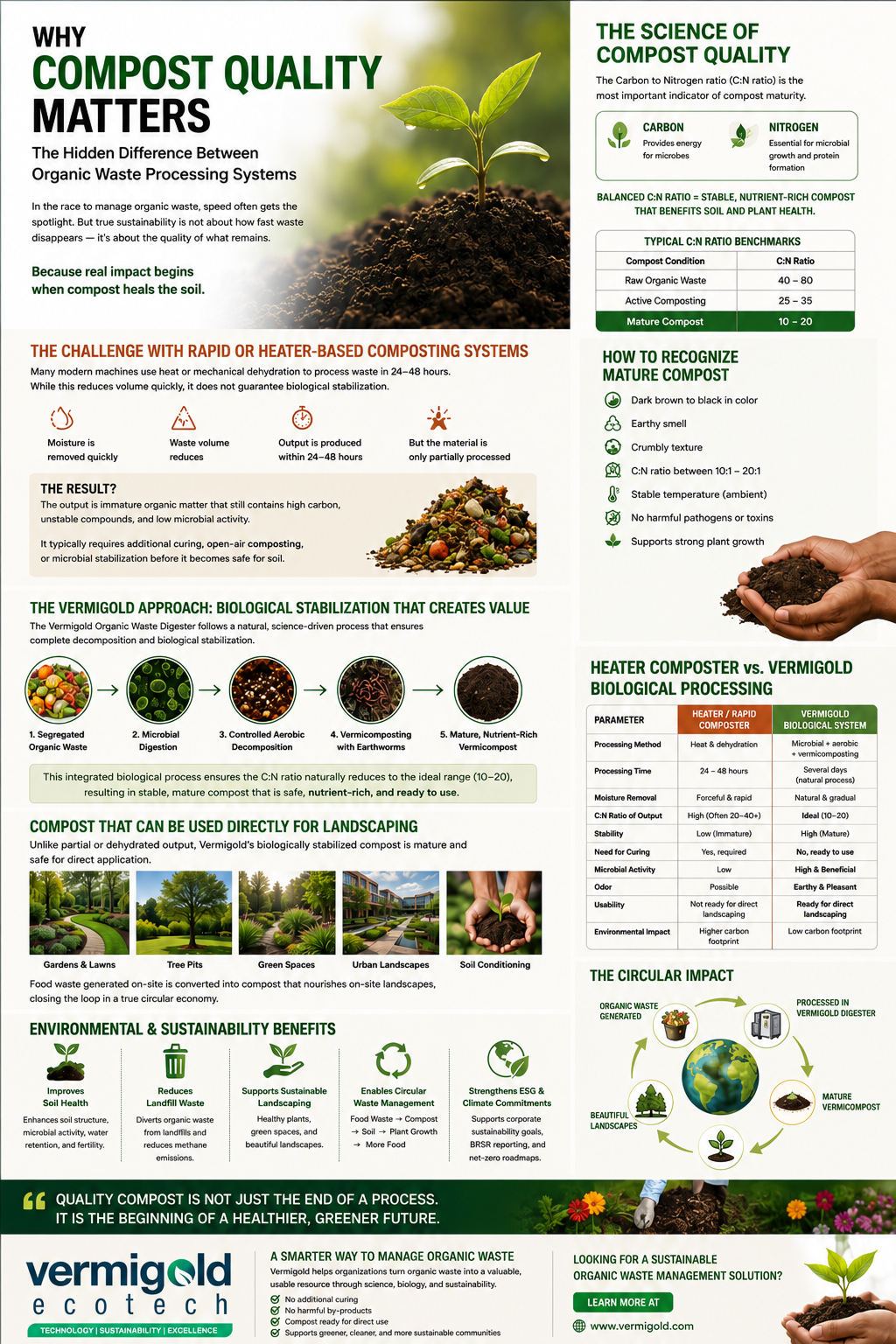
Because rapid drying is not the same as biological stabilization.
This is one of the most misunderstood realities in organic waste management.
Why Compost Quality Matters More Than Processing Speed
The true purpose of composting is not merely reducing waste volume.
The real purpose is to create:
Mature compost
Stable compost
Reusable compost
Biologically safe compost
that can safely return back to the soil.
This distinction is critical.
Because poorly stabilized compost may:
Continue decomposing after application
Generate odor
Attract pests
Reduce nitrogen availability for plants
Negatively affect landscaping performance
Many organizations discover this problem only after installation.
Initially, the machine appears efficient because waste volume decreases rapidly.
But later, they realize:
Compost curing is still required
Stabilization is incomplete
Compost usability is limited
Operational complexity increases
The result? What initially looked like a quick sustainability solution slowly becomes an operational compromise.
The Science Behind Compost Maturity
One of the most important indicators of compost quality is the:
Carbon-to-Nitrogen Ratio (C:N Ratio)
Microorganisms responsible for decomposition require:
Carbon for energy
Nitrogen for growth
Balanced decomposition depends on maintaining the correct biological relationship between the two.
Typical benchmarks include:
Compost Condition Typical C:N Ratio
Raw Organic Waste 40–80
Active Composting 25–35
Mature Compost 10–20
When compost remains biologically immature:
Microbial activity continues aggressively
Decomposition remains incomplete
Soil nutrients become unstable
Plant growth may weaken
This is why mature compost quality matters significantly more than processing speed alone.
The Shift Toward Biological Composting & Circular Waste Ecosystems
As sustainability awareness deepens, organizations are beginning to rethink what successful waste management truly means.
The conversation is evolving from:
“How quickly can waste disappear?”
to:
“How effectively can waste return safely back to nature?”
And this shift is redefining the future of organic waste infrastructure.
The Rise of Biological Composting Systems
Unlike thermal drying systems, biological composting works with natural decomposition cycles rather than forcing accelerated dehydration.
These systems rely on:
Microbial digestion
Oxygen-supported decomposition
Controlled aeration
Gradual biological stabilization
Vermicomposting processes
The objective is not simply speed.
The objective is:
complete biological transformation.
And the result is fundamentally different.
Why Vermicompost Creates Superior Environmental Value
High-quality vermicompost offers benefits that extend far beyond waste reduction.
It helps:
Improve soil fertility
Enhance microbial activity
Increase water retention
Support landscaping health
Reduce dependence on chemical fertilizers
For campuses, residential communities, and hospitality projects, this creates a powerful sustainability cycle:
Food Waste → Compost → Soil → Plant Growth → Greener Infrastructure
This is the foundation of circular waste management.
The Vermigold Approach
Designing Organic Waste Infrastructure Around Biology
At Vermigold Ecotech, organic waste management has always been viewed differently.
The philosophy is simple:
Waste management should not merely reduce waste volume. It should regenerate environmental value.
The Vermigold Organic Digester is designed around:
Biological stabilization
Controlled aerobic decomposition
Enhanced aeration
Modular digestion architecture
Vermicomposting integration
Instead of depending primarily on heat, the system supports gradual decomposition that converts food and garden waste into:
mature vermicompost suitable for direct landscaping applications.
This enables organizations to:
Reduce landfill dependency
Lower transportation emissions
Reduce operational energy consumption
Support ESG initiatives
Create sustainable green infrastructure
Most importantly: It transforms waste into a reusable environmental resource.
Why Compost Quality Matters for ESG & Sustainability Goals
Modern organizations are increasingly evaluated not only by operational efficiency — but by environmental accountability.
Today’s sustainability frameworks increasingly emphasize:
Circular economy principles
Resource recovery
Landfill reduction
Climate resilience
Decentralized infrastructure
This is why compost quality is no longer just an operational detail.
It is becoming a sustainability metric.
Because ultimately, mature compost reflects whether an organic waste management system is truly closing the environmental loop.
The Future of Waste Management Will Not Be Built Around Landfills
Cities of the future will not rely endlessly on transporting waste away from urban centers.
Instead, the future will be built around:
Decentralized processing
Biological stabilization
Circular ecosystems
Regenerative infrastructure
For apartments, hotels, campuses, hospitals, and institutions, choosing the right organic waste processing system is becoming one of the most important long-term sustainability decisions.
The best systems are not necessarily the fastest.
The most effective systems are those that:
Create mature compost
Support landscaping
Reduce environmental burden
Minimize operational complexity
Strengthen circular sustainability ecosystems
Because ultimately:
The goal of sustainable waste management is not simply to eliminate waste.
It is to return organic matter safely back to nature — where it can create life again.
About Vermigold Ecotech
Vermigold Ecotech develops decentralized climate infrastructure and biological organic waste management solutions for residential societies, hotels, campuses, institutions, and commercial facilities.
The Vermigold Organic Digester enables organizations to process food and biodegradable waste sustainably while generating mature vermicompost suitable for landscaping, soil improvement, and circular waste management ecosystems.