


The Invisible Crisis Growing Inside Modern Cities
Every day, across apartment complexes, hotels, educational campuses, hospitals, restaurants, and corporate offices, a silent cycle repeats itself.
Food is prepared. Meals are served. Landscapes are maintained. Communities function.
And alongside all of this, organic waste quietly accumulates.
Vegetable peels. Leftover food. Garden waste. Dry leaves. Cafeteria waste.
For decades, cities treated this waste as something to be removed and forgotten.
Waste collection trucks arrived. Garbage disappeared. Landfills expanded further outside city boundaries.
Out of sight. Out of mind.
But today, the consequences of that system are becoming impossible to ignore.
Urban landfills are overflowing. Transportation costs are increasing. Methane emissions are accelerating climate change. Environmental regulations are tightening. Communities are demanding cleaner and greener infrastructure.
And organizations everywhere are beginning to realize something important:
Waste management is no longer just a sanitation issue.
It is now:
An environmental issue
An operational issue
An ESG issue
A climate issue
An infrastructure issue
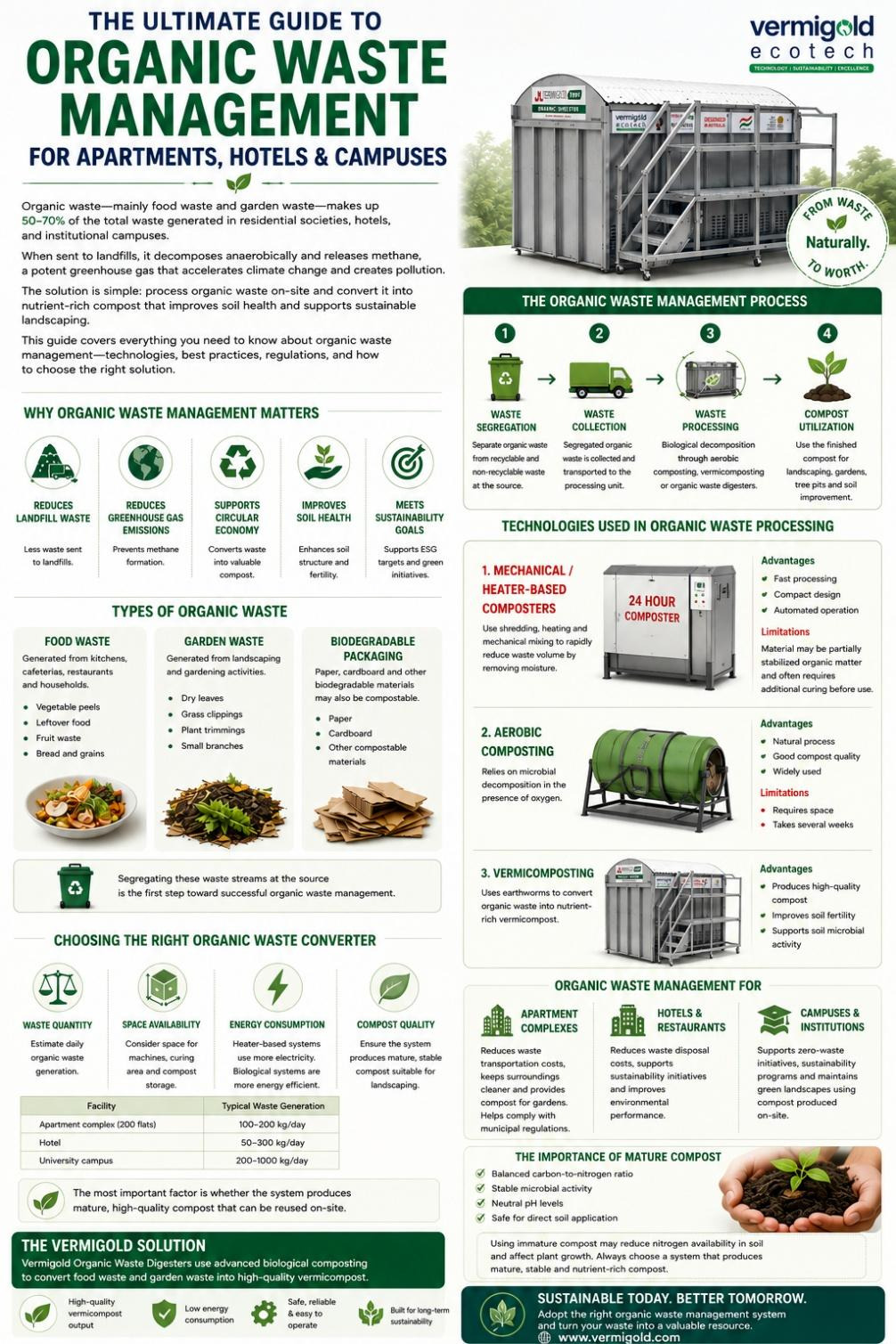
This is why apartments, hotels, campuses, and institutions are increasingly investing in Organic Waste Management Systems and Organic Waste Converters (OWCs) to process biodegradable waste directly at source.
But once organizations decide to process waste internally, a new challenge immediately appears:
What is the right organic waste management system for long-term sustainability?
Because not all systems create the same environmental outcome.
The Mistake Most Organizations Make When Choosing an Organic Waste Converter
For many facilities, selecting an Organic Waste Converter initially appears straightforward.
Vendors promise:
Rapid waste reduction
Odor control
Lower landfill dependency
Sustainability benefits
Operational convenience
And naturally, the fastest-looking solution often appears the most attractive.
But this is where many organizations unknowingly make a costly long-term mistake.
Because the real purpose of an organic waste management system is not simply:
“making waste disappear quickly.”
The real purpose is:
converting organic waste into a stable, reusable environmental resource.
This distinction changes everything.
Why Organic Waste Is a Much Bigger Problem Than Most People Realize
In most urban buildings and campuses, organic waste forms the largest component of total municipal waste generation.
In many cases:
Food waste + garden waste = 50–70% of the total waste stream.
When this waste reaches landfills, it decomposes anaerobically and releases methane — a greenhouse gas significantly more potent than carbon dioxide.
The environmental impact becomes enormous:
Increased greenhouse gas emissions
Landfill burden
Odor generation
Leachate contamination
Rising waste transportation emissions
At the same time, organizations also face increasing pressure from:
ESG reporting frameworks
BRSR compliance
Green building certifications
Sustainability audits
Stakeholder expectations
Suddenly, waste management is no longer just about disposal.
It becomes part of corporate environmental responsibility.
The Hidden Difference Between Composting Technologies
One of the biggest misconceptions in the market is that all composting technologies work similarly.
In reality, Organic Waste Converters generally fall into three very different categories:
1. Heater-Based Composters
These systems use:
Electrical heaters
Mechanical mixing
Rapid moisture removal
The objective is fast waste volume reduction.
While processing speed may appear attractive, the output often requires:
Additional curing
Biological stabilization
Further decomposition
before safe landscaping use.
2. Aerobic Composting Systems
These systems rely on:
Microbial activity
Oxygen flow
Controlled decomposition
The process is slower but more biologically stable.
3. Vermicomposting Systems
These systems integrate:
Microbial decomposition
Earthworm-assisted stabilization
Natural biological processing
The result is mature vermicompost widely regarded as one of the highest-quality organic soil amendments.
Why Compost Quality Matters More Than Processing Speed
Many organizations initially focus on:
“How quickly can the machine process waste?”
But over time, experienced operators realize the more important question is:
“How useful is the final compost?”
High-quality compost should:
Be biologically stable
Support landscaping
Improve soil fertility
Enhance microbial activity
Reduce dependence on chemical fertilizers
Immature compost, however, can:
Generate odour
Continue decomposing after application
Attract pests
Negatively impact plant growth
This is why compost maturity and biological stabilization matter significantly more than rapid dehydration alone.
The Global Shift Toward Circular & Decentralized Waste Infrastructure
Across the world, a major shift is now underway.
Cities and institutions are slowly moving away from:
centralized waste disposal systems
toward:
decentralized circular waste management ecosystems.
Instead of transporting organic waste long distances to landfills, organizations are increasingly processing waste directly where it is generated.
This changes the sustainability equation entirely.
Waste is no longer viewed as a disposal burden.
It becomes:
Compost
Soil nutrition
Landscaping input
Environmental value
The sustainability loop becomes:
Food Waste → Compost → Soil → Plant Growth
This is the foundation of circular waste infrastructure.
The Vermigold Approach
Building Climate-Conscious Infrastructure Through Biology
At Vermigold Ecotech, organic waste management is viewed not as a disposal challenge — but as a biological resource recovery opportunity.
The Vermigold Organic Digester is designed around:
Decentralized biological composting
Enhanced aeration
Modular digestion architecture
Gravity-assisted waste flow
Vermicomposting stabilization
Unlike systems focused primarily on rapid thermal drying, the Vermigold approach prioritizes:
biological stabilization and compost maturity.
This enables organizations to generate mature vermicompost suitable for:
Landscaping
Gardens
Campuses
Tree pits
Soil conditioning
At the same time, the system helps organizations:
Reduce landfill disposal
Lower transportation emissions
Reduce operational energy consumption
Support ESG goals
Create greener and healthier environments
This transforms waste management into:
sustainable environmental infrastructure.
Why Operational Simplicity Is Equally Important
One of the most overlooked aspects of organic waste management is daily operational usability.
Even advanced systems fail if they become difficult to operate consistently.
Organizations should evaluate:
́Ease of feeding
Maintenance requirements
Housekeeping integration
Space requirements
Compost handling workflow
Long-term operating cost
The best waste management systems are not only environmentally sustainable - they are operationally sustainable as well.
The Future of Waste Management Will Be Biological, Local & Circular
The future of cities will not be built around endlessly transporting waste across urban landscapes.
The future will be built around:
Decentralized infrastructure
Biological processing
Circular resource recovery
Sustainable ecosystems
For apartments, hotels, campuses, hospitals, and institutions, selecting the right organic waste management system is becoming one of the most important long-term sustainability decisions.
The most effective systems are not necessarily the fastest.
The best systems are those that:
Create mature compost
Reduce environmental impact
Improve operational efficiency
Support ESG commitments
Strengthen circular sustainability ecosystems
Because ultimately:
The goal of organic waste management is not merely to eliminate waste.
It is to return organic matter safely back to nature - where it can create life again.
About Vermigold Ecotech
Vermigold Ecotech develops decentralized climate infrastructure and biological organic waste management solutions for apartments, hotels, institutions, campuses, and commercial facilities.
The Vermigold Organic Digester enables organizations to convert food and biodegradable waste into mature vermicompost suitable for landscaping, soil improvement, and circular waste management ecosystems.