

The Waste Problem Most Cities Can No Longer Ignore
Every morning, across apartment complexes, hotels, corporate campuses, hospitals, universities, and institutions, the same invisible cycle quietly begins again.
Kitchen waste accumulates. Cafeterias generate food scraps. Landscaping waste piles up. Bins overflow.
And by the end of the day, tons of biodegradable waste leave buildings and communities to begin another journey toward already overloaded landfills.
For years, this process was accepted as normal.
Waste was something to be collected, transported, and discarded.
But today, the world is changing.
Cities are becoming denser. Landfills are reaching capacity. Environmental regulations are tightening. ESG reporting is becoming mainstream. Organizations are being measured not only by profitability — but by sustainability.
Across industries, institutions are now asking a very different question:
“How do we build infrastructure that is environmentally responsible, operationally efficient, and future-ready?”
This is why organic waste management has moved from being a housekeeping function to becoming a critical part of sustainable infrastructure planning.
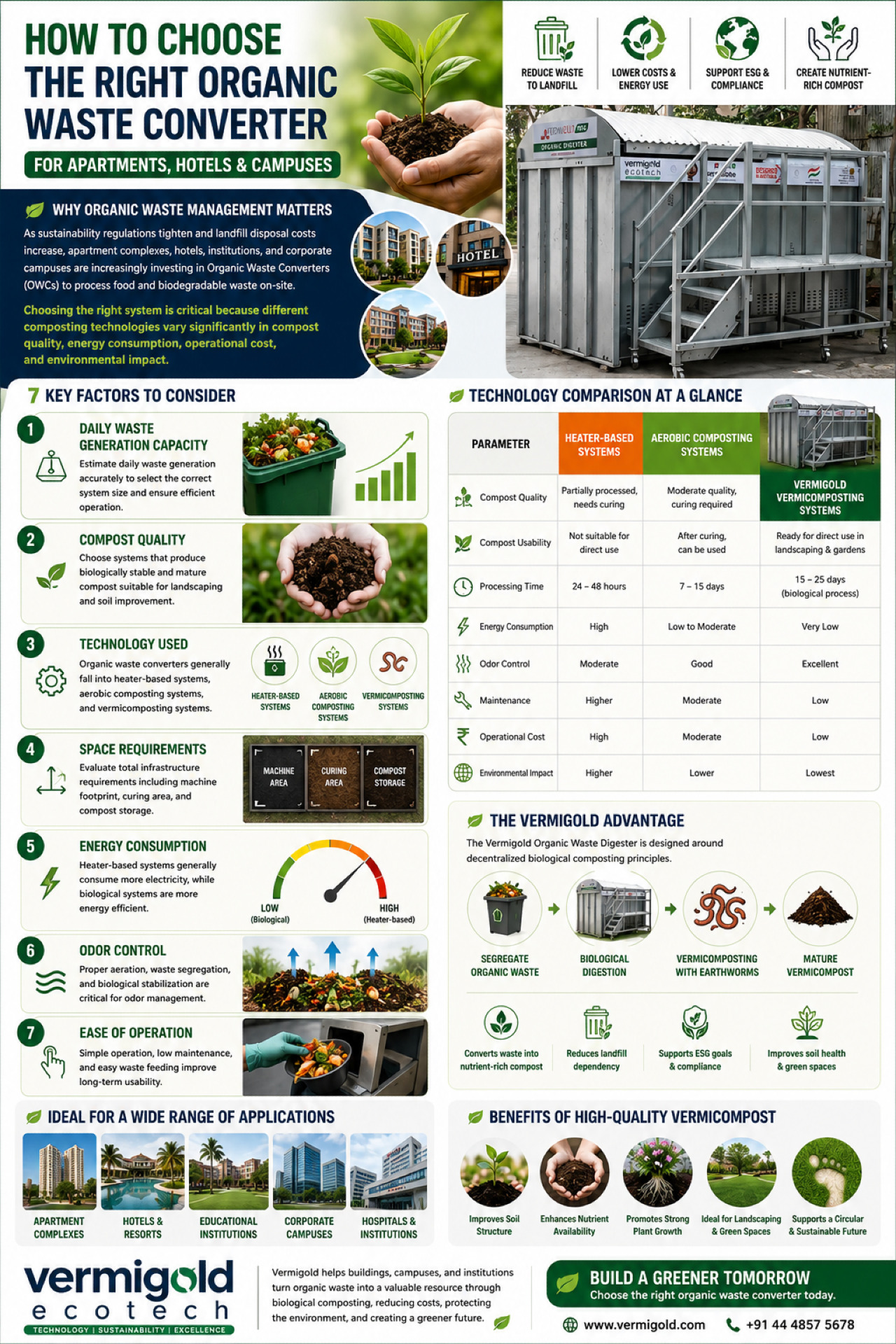
And increasingly, organizations are turning toward Organic Waste Converters (OWCs) to process food and biodegradable waste directly at source.
But once the decision to process waste on-site is made, another challenge immediately emerges:
Which organic waste management system actually works best?
Because not all composting technologies create the same environmental outcome.
The Confusing Reality Behind Organic Waste Converter Technologies
For many apartment complexes, hotels, and institutions, choosing an Organic Waste Converter initially appears straightforward.
Most vendors promise:
Rapid processing
Odor control
Compact footprint
Lower landfill waste
Sustainability benefits
On the surface, many systems seem similar.
But beneath the marketing language, the technologies are fundamentally different.
And this difference affects:
Compost quality
Operating cost
Energy consumption
Maintenance
Environmental impact
Long-term usability
The biggest mistake many organizations make is focusing only on:
“How fast can waste be processed?”
Because waste reduction speed alone does not determine whether a system is truly sustainable.
The Hidden Cost of Choosing the Wrong System
In many facilities, the excitement of installing an organic waste converter quickly turns into operational frustration.
Some systems consume unexpectedly high electricity. Some generate unstable compost. Some require continuous curing and post-processing. Some create operational complexity for housekeeping teams. Some fail to integrate smoothly into daily waste workflows.
Over time, organizations realize that selecting an Organic Waste Converter is not merely a purchase decision.
It is an infrastructure decision.
And infrastructure decisions live for years.
This is where understanding the underlying composting technology becomes critically important.
Why Compost Quality Matters More Than Most Buyers Realize
The true purpose of an organic waste management system is not simply reducing waste volume.
The real objective is to create:
Biologically stable compost
Reusable compost
Environmentally safe compost
Nutrient-rich organic matter suitable for landscaping and soil improvement
Unfortunately, many organizations discover too late that not all composting systems produce mature compost.
Some heater-based systems primarily focus on:
Thermal drying
Rapid moisture reduction
Accelerated volume reduction
While these systems may process waste quickly, the biological decomposition cycle may still remain incomplete.
The output may still require:
Curing
Stabilization
Additional microbial activity
before becoming suitable for landscaping applications.
This creates hidden operational complexity that many buyers do not anticipate initially.
Because ultimately, the question is not:
“How quickly did the machine reduce waste?”
The real question is:
“Can the final compost safely and effectively return to the soil?”
The Shift Toward Biological Composting & Circular Waste Infrastructure
As organizations become more sustainability-focused, the industry itself is evolving.
The conversation is slowly shifting from:
“How fast can waste disappear?”
to:
“How effectively can waste become a valuable environmental resource?”
This shift changes the way modern waste management systems are evaluated.
Today, forward-looking organizations increasingly prioritize:
Compost quality
Biological stabilization
Lower energy consumption
Operational simplicity
Circular resource recovery
ESG alignment
This is why biological composting systems are becoming increasingly relevant.
Understanding the Three Major Organic Waste Processing Technologies
1. Heater-Based Composters
These systems use:
Electrical heaters
Mechanical mixing
Thermal dehydration
The objective is rapid moisture removal and fast volume reduction.
While processing times may appear attractive, the compost often requires further curing before stable use.
2. Aerobic Composting Systems
These systems rely on:
Microbial decomposition
Oxygen flow
Controlled aeration
The process is slower but more biologically stable.
3. Vermicomposting Systems
These systems integrate:
microbial decomposition
Earthworm-assisted stabilization
Natural biological processing
The result is high-quality vermicompost that improves:
Soil fertility
Microbial activity
Landscaping quality
Water retention
Among biological waste processing methods, vermicomposting is widely recognized for producing one of the most nutrient-rich forms of compost.
The Vermigold Approach
Designing Waste Infrastructure Around Biology, Not Just Speed
At Vermigold Ecotech, the philosophy behind waste management is fundamentally different.
The Vermigold Organic Digester was designed around one core belief:
Organic waste should become a reusable environmental resource — not simply a reduced waste volume.
Instead of depending primarily on heat, the Vermigold system supports:
Controlled biological decomposition
Enhanced aeration
Modular digestion architecture
Gravity-assisted waste flow
Vermicomposting stabilization
This enables gradual and stable organic waste processing that supports the generation of mature vermicompost suitable for:
Landscaping
Gardens
Soil conditioning
Green campus infrastructure
The system also helps organizations:
Reduce landfill dependency
Lower transportation emissions
Reduce operational energy consumption
Support ESG and BRSR goals
Create decentralized circular waste ecosystems
This transforms waste management from a disposal function into a sustainability asset.
Why Operational Simplicity Matters
One of the most overlooked aspects of organic waste management is daily usability.
Even technically advanced systems fail if they become operationally difficult.
Organizations should evaluate:
Ease of feeding
Housekeeping workflow integration
Loading and unloading simplicity
Maintenance requirements
Long-term operating cost
Infrastructure scalability
The best systems are not only environmentally sustainable — they are operationally sustainable as well.
The Future of Waste Management Is Circular, Biological & Decentralized
The future of sustainable infrastructure will not be built around transporting waste endlessly across cities.
It will be built around:
Decentralized processing
Biological stabilization
Circular resource recovery
Climate-conscious infrastructure
For apartments, hotels, campuses, hospitals, and institutions, selecting the right Organic Waste Converter is becoming a long-term environmental and operational decision.
The most effective systems are not simply the fastest.
The best systems are those that:
Produce mature compost
Create reusable environmental value
Reduce operational burden
Support sustainability goals
Integrate naturally into daily operations
Contribute to healthier urban ecosystems
Because ultimately:
The goal of organic waste management is not merely to make waste disappear.
It is to return organic matter safely back to nature — where it can create life again.
About Vermigold Ecotech
Vermigold Ecotech develops decentralized climate infrastructure and biological organic waste management solutions for residential societies, hotels, institutions, campuses, and commercial facilities.
The Vermigold Organic Digester enables organizations to process food and biodegradable waste sustainably while generating mature vermicompost suitable for landscaping and circular waste management ecosystems.