It happened outside a gated residential society in Mumbai. What once left the premises as black garbage bags now emerged as something entirely different — fresh, nutrient-rich compost, collected every week. One morning, a local farmer stopped at the gate and asked a simple question: “Can I buy your compost?”
In that moment, waste revealed its true potential. What had always been treated as a liability had quietly become a resource. That is the essence of the circular economy — where materials don’t end their journey after use, but begin a new one.
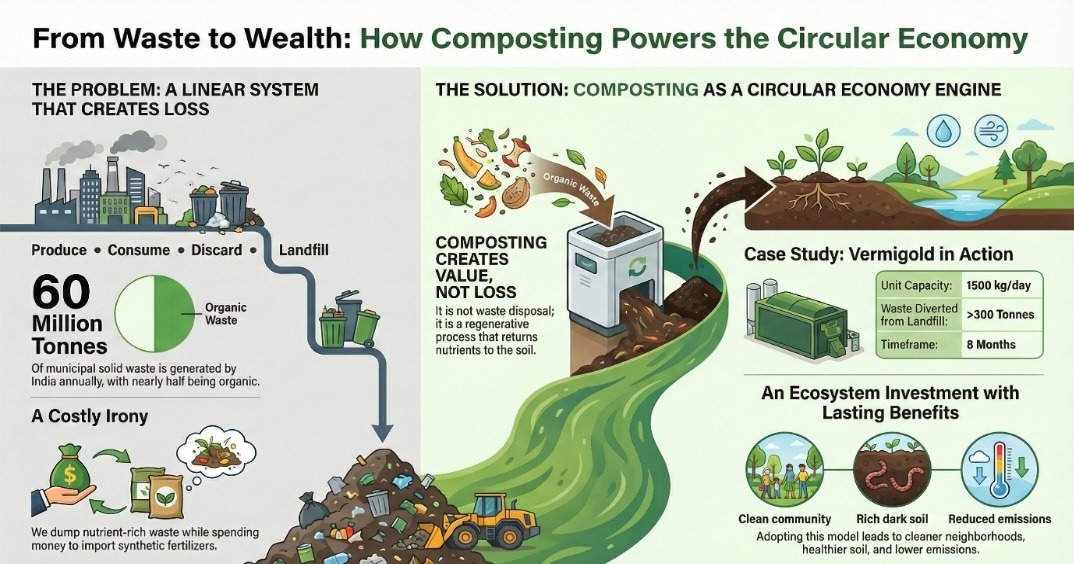
India’s Linear Waste Crisis: A System Stuck at Landfill
Despite the promise of examples like the one above, most Indian cities still follow a linear model:
Produce → Consume → Discard → Landfill
India generates over 60 million tonnes of municipal solid waste every year, and nearly half of it is organic. Instead of returning nutrients to the soil, this waste decomposes in landfills, releasing methane — a greenhouse gas significantly more potent than carbon dioxide.
The economic costs compound the environmental ones. Municipalities spend heavily on waste collection, transport, and landfill maintenance. Meanwhile, India imports synthetic fertilisers to replenish depleted farmland — while dumping nutrient-rich organic matter daily. The problem and the solution exist in the same waste bin. Yet the system remains stuck in a “use and forget” mindset.
Composting as the Engine of a Circular Economy
The circular economy offers a fundamentally different approach — and composting sits at its core. Composting is not merely about waste disposal. It is about regeneration.
When supported by the right technology, organic waste can re-enter the economic and ecological cycle with purpose. Vermigold’s award-winning Organic Waste Digester makes this transformation possible. As a continuous-flow, in-vessel vermicomposting system, it converts food waste into fully mature, high-nutrient vermicompost in just 8–10 days — meeting MoEFCC (Ministry of Environment, Forests & Climate Change) norms — without foul odour, greenhouse gas emissions, or leachate.
Available in capacities from 50 kg/day to 2,000 kg/day and beyond, the system is designed for apartment societies, corporate campuses, hotels, institutions, and municipalities across India.
Circular Economy in Action A Military Station in Rajasthan
At a Military Station in Rajasthan, a Vermigold unit processing 1,500 kg of waste per day diverted more than 300 tonnes of organic waste from landfills within just eight months. The compost generated was applied directly for on-site soil regeneration — creating a self-sustaining, localised loop that required no dependence on municipal infrastructure.
The cycle was simple and powerful:
Food waste became vermicompost
Vermicompost regenerated degraded soil
Healthier soil supported agriculture that fed the community again
This is circularity in action — where value is created, not lost.
Why Vermicomposting Outperforms Conventional Composting
Not all composting technologies are equal. Traditional windrow or pit-based composting is slow, land-intensive, and odour-prone. In contrast, vermicomposting — which uses specially selected earthworm blends (including African Nightcrawlers and Eisenia Foetida) — delivers:
Up to 90% waste volume reduction
Zero greenhouse gas emissions
No leachate, no odour, minimal footprint
High-nutrient compost and liquid fertiliser ready for immediate use
The lowest power consumption of any automated composter in its class
The Vermigold Organic Waste Digester is recognised by the Government of India’s Ministry of Housing and Urban Affairs in its advisory on decentralised composting under the Swachh Bharat Mission, and is included in the NSW Government of Australia’s Better Practice Guidelines for waste management — a testament to its global credibility.
Composting Is an Ecosystem Investment, Not an Expense
Communities and organisations that embed composting within a circular economy framework consistently see compounding returns — environmental and economic:
Cleaner neighbourhoods and reduced landfill dependency
Healthier soil, stronger food systems, reduced import of synthetic fertilisers
New livelihoods in the bioeconomy — as the Mumbai farmer discovered
Measurable carbon footprint reduction and climate-positive outcomes
Whether you are a municipality, a gated community, a food business, a hotel, or a corporate campus — the opportunity is the same: close the loop and transform organic waste into regenerative, monetisable value.
Start Your Circular Economy Journey with Vermigold
The journey from waste to wealth does not begin in landfills. It begins with rethinking your waste systems — and choosing technology that closes the loop reliably, cleanly, and at scale.
Vermigold’s Organic Waste Digester has been proven across military stations, corporate parks, residential communities, and food processing facilities across India. Our award-winning systems are built to last, backed by science, and designed for Indian conditions.
Explore our range of Organic Waste Digesters at www.vermigold.com or contact us to find the right solution for your needs.
Vermigold Ecotech Pvt. Ltd. | Mumbai, India | Global Award-Winning Cleantech Waste Management