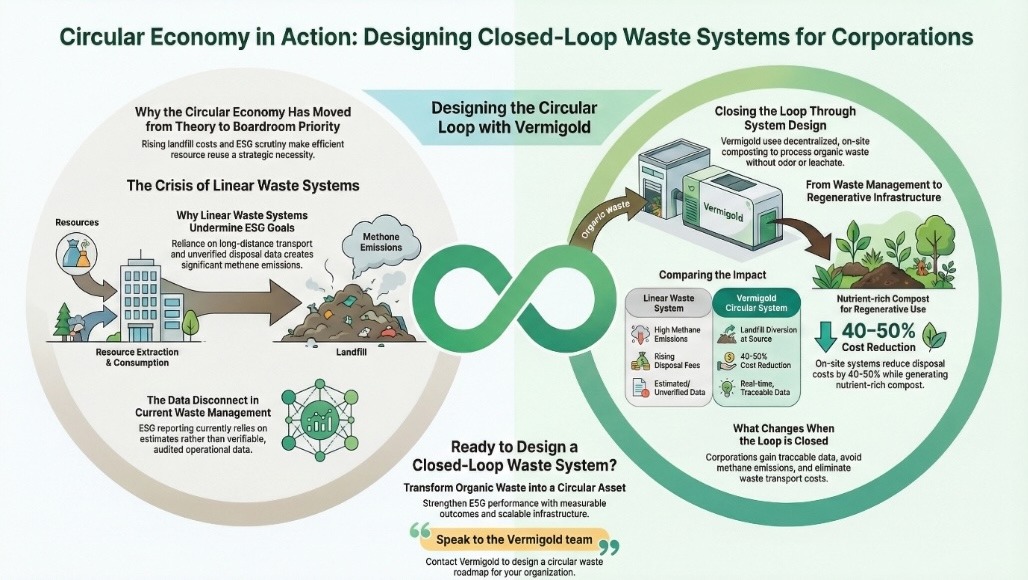
Why the Circular Economy Has Moved from Theory to Boardroom Priority
For decades, corporations operated on a simple economic logic: extract resources, manufacture products, consume, and discard what remained. This linear model powered global growth—but it also created an equally global waste problem.
Today, that model is breaking down.
Rising landfill costs, climate risk, tightening regulations, and growing ESG scrutiny have forced organisations to rethink how materials flow through their operations. Sustainability is no longer measured by intent alone, but by outcomes—especially how efficiently resources are used and reused.
This shift has brought the circular economy from academic theory into corporate strategy. At its core, the circular economy asks a fundamental question: What if waste was not the end of the process, but the beginning of the next one?
Why Linear Waste Systems Undermine ESG Goals
Most large corporations publicly support circularity. Yet on the ground, many still operate linear waste systems—particularly when it comes to organic waste.
The challenges are structural:
Organic waste is mixed, outsourced, and transported long distances
Waste vendors offer disposal, not data or traceability
Sustainability teams struggle to measure real diversion or emissions impact
Landfills continue to generate methane from biodegradable waste
ESG reporting relies on estimates instead of verifiable systems
The result is a disconnect. While companies speak about circular economy principles, their waste continues to follow a one-way path to landfills.
In a linear system, waste represents loss—of material value, energy, nutrients, and credibility. And for organisations aiming to strengthen ESG performance, this loss becomes increasingly difficult to justify.
Closing the Loop Through System Design
The circular economy becomes real when waste is redesigned as part of an internal operating system, not an external afterthought.
For corporations, this transformation begins with organic waste—the single largest and most recoverable waste stream across offices, campuses, factories, and food services.
A closed-loop waste system follows three core principles:
Decentralisation – Waste is processed close to where it is generated
Biological recovery – Organic waste is returned safely to natural cycles
Measurability – Outcomes are tracked, audited, and reported
This is where on-site organic waste processing plays a critical role.
At Vermigold Ecotech, circular economy thinking is applied through decentralised composting systems that convert organic waste into nutrient-rich compost within days—without odour, leachate, or heavy energy use.
Instead of exporting waste, corporations retain control over it.
What changes when the loop is closed:
Food and biodegradable waste is diverted from landfills at source
Methane emissions from disposal are avoided
Compost is reused for landscaping, green belts, or local agriculture
Waste transport and disposal costs fall significantly
ESG reporting shifts from estimates to real operational data
In practical terms, one corporate facility can divert hundreds of tonnes of organic waste annually, reduce disposal costs by 40–50%, and generate a valuable soil input—turning a cost centre into a circular asset.
This is the circular economy in action: not recycling for optics, but system-level redesign.
From Waste Management to Regenerative Infrastructure
The most important lesson for corporations is this:
Circularity cannot be outsourced. It must be designed.
When waste systems are decentralised, measured, and biologically integrated, sustainability stops being an initiative and becomes infrastructure. Circular economy principles move from strategy decks into daily operations.
For ESG leaders, this delivers more than environmental benefits. It strengthens governance through traceable data, improves social impact through employee engagement and local ecosystems, and reduces long-term risk tied to landfills and regulation.
The circular economy is not about doing more with less.
It is about ensuring that materials never lose their value in the first place.
For corporations ready to move beyond linear waste models, closed-loop systems offer a clear path forward—one where waste is no longer an endpoint, but a resource that continually feeds the system.
That is how circular economy principles translate into real, measurable corporate impact.
Ready to Design a Closed-Loop Waste System?
🌱 Transform organic waste into a circular asset
📊 Strengthen ESG performance with measurable outcomes
♻️ Build waste infrastructure that scales across sites
👉 Speak with the Vermigold team to design a circular waste roadmap for your organisation.