A World That Produces Enough—Yet Wastes Too Much
Every day, food is grown, processed, transported, and prepared using enormous amounts of land, water, energy, and human effort. Yet across homes, restaurants, institutions, and supply chains, a significant portion of that food never reaches a plate.
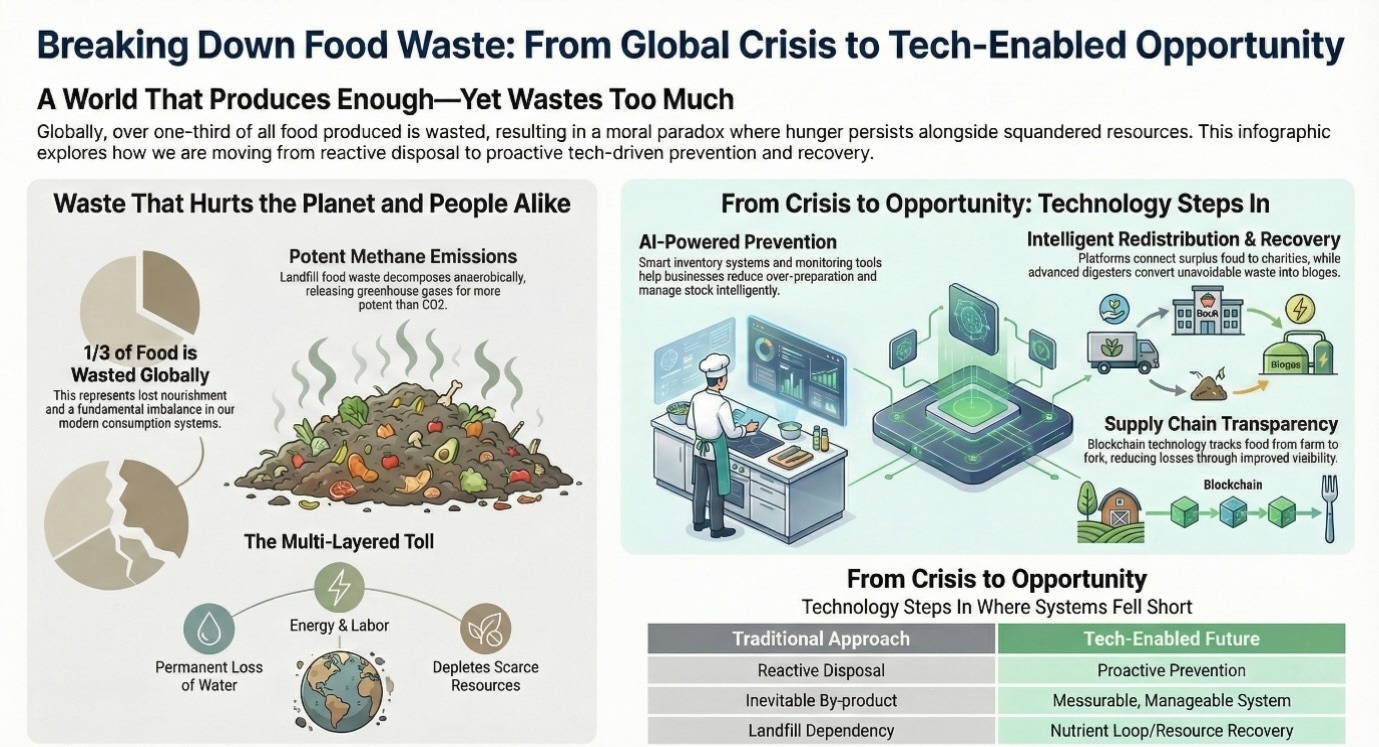
Globally, more than one-third of all food produced is wasted. This isn’t just a statistic—it represents lost nourishment, squandered resources, and a system that is fundamentally out of balance.
As populations grow and pressure on natural resources intensifies, food waste has become one of the most visible contradictions of modern consumption. Solving it is no longer optional; it is essential.
Waste That Hurts the Planet and People Alike
When food waste ends up in landfills, it doesn’t simply disappear. It decomposes anaerobically, releasing methane—a greenhouse gas far more potent than carbon dioxide. At the same time, the water, energy, fertilisers, and labour used to produce that food are permanently lost.
The consequences are multi-layered:
Environmental damage through emissions and land degradation
Economic losses across agriculture, logistics, retail, and hospitality
Resource depletion in a world already facing scarcity
A moral paradox where food is wasted while hunger persists
For years, food waste was seen as an inevitable by-product of scale. But that assumption is now being challenged.
Technology Steps In Where Systems Fell Short
The turning point lies in how technology is reshaping food waste management—shifting it from reactive disposal to proactive prevention and recovery.
At the source, smart inventory systems are changing behaviour.
AI-powered tools help households and businesses track expiry dates, manage stock intelligently, and even suggest how surplus ingredients can be used before they spoil. Platforms connecting consumers with surplus food from restaurants and retailers are helping prevent waste before it occurs.
Data and analytics are revealing hidden patterns.
In commercial kitchens and food production environments, AI-based waste monitoring systems analyse what is being discarded and why. These insights allow businesses to fine-tune procurement, portioning, and production—reducing over-preparation and unnecessary disposal.
Redistribution networks are closing the gap between surplus and scarcity.
Technology-enabled platforms now connect excess food from businesses directly to charities and food banks. By optimising logistics and timing, edible food is redirected from landfills to people who need it most.
When waste is unavoidable, processing has evolved.
Advanced composting systems and organic waste digesters accelerate the breakdown of food waste into compost, liquid fertiliser, or biogas. Solutions like Vermigold’s Organic Waste Digester use biological processes to convert food waste into valuable by-products—reducing landfill dependency while closing the nutrient loop.
Transparency across supply chains is improving.
Blockchain technology is increasingly used to track food from farm to fork, reducing losses caused by mismanagement, overstocking, and lack of visibility across complex supply networks.
Together, these technologies transform food waste from an overlooked problem into a measurable, manageable system.
From Crisis to Opportunity
Food waste is one of the rare global challenges where solutions already exist—and where action delivers immediate environmental, economic, and social benefits.
As innovations continue to emerge—AI-driven waste segregation, robotics for food sorting, zero-waste retail models—the opportunity to redesign how we value food becomes clearer. Technology alone won’t solve the problem, but it provides the tools needed to act decisively and at scale.
Reducing food waste is no longer about better disposal.
It’s about better systems.
When food is managed intelligently, resources are conserved, emissions are reduced, and communities benefit. The future of food waste management is tech-enabled, sustainable, and urgent—and the choices made today will determine how responsibly we feed the world tomorrow.
👉 Connect with the Vermigold team to design verifiable sustainability systems for your organisation.