Why Zero Waste Is Now a Core ESG Imperative
Environmental, Social, and Governance (ESG) performance has moved from the margins of corporate reporting to the centre of strategic decision-making. Investors demand measurable outcomes. Regulators expect verifiable compliance. Customers and employees increasingly judge companies by the integrity of their sustainability actions.
Within this shift, zero waste to landfill has emerged as a defining benchmark. Not because it is easy—but because it reveals whether sustainability is embedded into operations or confined to reporting narratives.
For large corporations with complex supply chains, multiple facilities, and high-volume fwaste generation, achieving zero waste is not a communications exercise. It is a systems challenge.
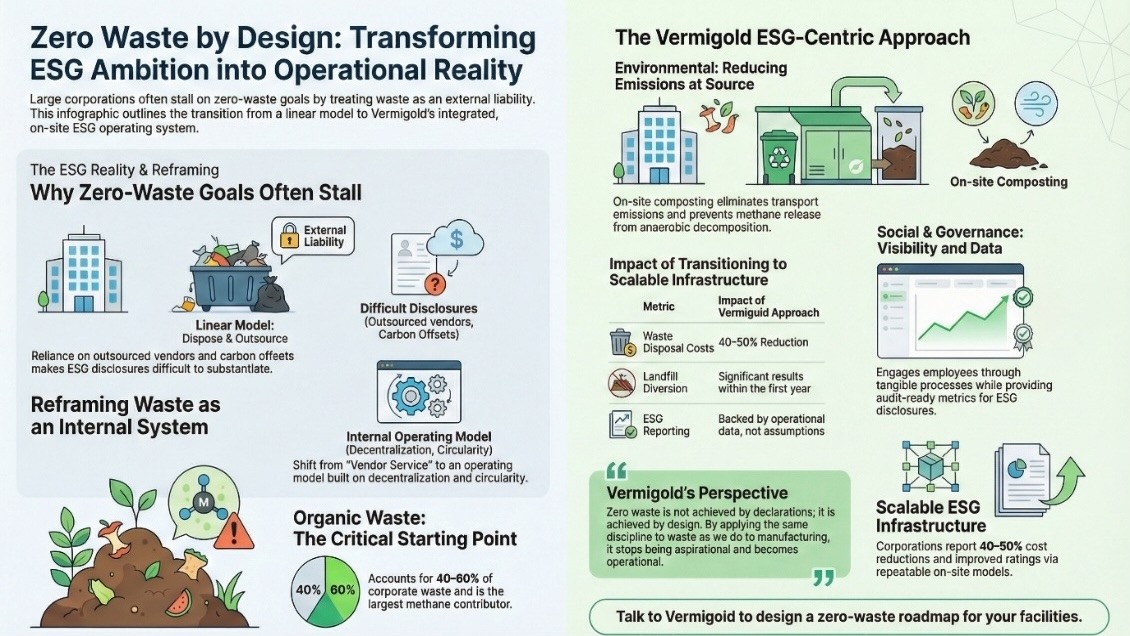
The ESG Reality: Why Zero-Waste Goals Often Stall
Most corporations do not fail at zero waste due to lack of intent. They fail because their operational models were never designed for it.
Common structural barriers include:
Outsourced waste management with limited traceability, making ESG disclosures difficult to substantiate
Overreliance on landfills and off-site vendors, especially for organic waste streams
Reactive compliance behaviour, driven by audits rather than continuous improvement
Carbon offsets used as substitutes for waste reduction, rather than addressing emissions at source
Low employee engagement, because waste remains invisible and external
As a result, many organisations remain trapped in a linear model:
Procure → Consume → Dispose → Outsource → Report
In this model, waste is treated as an external liability—something to be moved away from operations as quickly as possible. ESG performance, however, demands the opposite: visibility, accountability, and measurable reduction.
Reframing Waste as an ESG System
Zero waste becomes achievable only when waste management is treated as an internal operating system, not a vendor service.
This shift requires three foundational changes:
Decentralisation – Processing waste closer to where it is generated
Measurement – Capturing data that supports ESG, CSR, and regulatory reporting
Circularity – Returning organic waste to productive use instead of discarding it
Organic waste is the most critical starting point. It typically accounts for 40–60% of total corporate waste and is the largest contributor to landfill methane emissions.
Vermigold’s ESG-Centric Waste Management Approach
At Vermigold Ecotech, waste management is engineered as an ESG solution—not merely an environmental one.
Vermigold’s on-site organic waste management systems enable corporations to redesign waste flows across manufacturing plants, corporate campuses, IT parks, institutional kitchens, and commercial facilities.
1. Environmental Impact: Reducing Emissions at Source
When organic waste is landfilled, it decomposes anaerobically and releases methane—a greenhouse gas significantly more potent than CO₂.
Vermigold’s decentralised composting systems:
Divert organic waste from landfills at source
Eliminate emissions from waste transportation
Convert biodegradable waste into nutrient-rich compost within days
Operate with no leachate, no foul odour, and minimal energy use
This directly supports carbon reduction goals and strengthens Scope 3 emissions performance.
2. Social Impact: Engaging People, Not Just Processes
ESG outcomes are not delivered by machines alone—they depend on participation.
By processing waste on-site, Vermigold systems:
Make waste visible, tangible, and measurable
Enable employee engagement through segregation, awareness, and compost utilisation
Support local ecosystems through landscaping, green belts, and urban agriculture
Create opportunities for local circular economies and green livelihoods
Waste stops being hidden—and begins to educate.
3. Governance Impact: Data, Compliance, and Audit Readiness
Governance is where many sustainability initiatives fail—not due to lack of action, but lack of evidence.
Vermigold’s approach supports governance through:
Quantifiable waste diversion metrics
Audit-ready documentation for ESG, CSR, and statutory disclosures
Alignment with zero-waste, circular economy, and environmental compliance frameworks
Reduction in compliance risk related to greenwashing or unverifiable claims
For sustainability leaders, this translates into confidence—being able to walk into board meetings or audits with data, not assumptions.
From Pilot Projects to Scalable ESG Infrastructure
Large corporations that adopt decentralised organic waste management consistently report:
40–50% reduction in waste disposal costs
Significant landfill diversion within the first year
Improved ESG ratings backed by operational data
Replicable models across multiple sites and geographies
What begins as a sustainability initiative becomes infrastructure—scalable, repeatable, and embedded into daily operations.
Zero Waste Is Not a Target. It’s an Operating Model.
The most important ESG insight is this:
Zero waste is not achieved by declarations.
It is achieved by design.
Corporations already excel at building complex systems—manufacturing lines, supply chains, compliance frameworks, and digital infrastructure. Applying that same discipline to waste management is what transforms ESG ambition into ESG performance.
When waste is decentralised, measured, and reintegrated into productive use, zero waste stops being aspirational.
It becomes operational.
The Vermigold Perspective on ESG Leadership
At Vermigold, we believe sustainable waste management is foundational to credible ESG performance.
Not because it looks good in reports—but because it delivers real, measurable outcomes across environmental impact, social engagement, and governance accountability.
For large corporations navigating the next decade of ESG expectations, the question is no longer whether to pursue zero waste.
It is how systematically they do it.
Ready to Build ESG-Grade Waste Infrastructure?
🌱 Design zero-waste systems that scale with your organisation.
📊 Strengthen ESG, CSR, and compliance reporting with real data.
♻️ Turn organic waste into a circular economy asset.
👉 Talk to the Vermigold sustainability team to design a zero-waste roadmap for your facilities.